

CE Marking Certification
ACCESS THE EUROPEAN MARKET
CE Marking Certification Services for European Market Access
Planning to export products to Europe? CE marking confirms that a product meets the applicable European Union (EU) requirements. Manufacturers and exporters need to understand the relevant regulations, technical documentation and conformity assessment procedures before placing products on the European market.
ICV Assessments Pvt. Ltd. helps businesses understand CE marking requirements, product compliance and the CE marking process. Our guidance helps manufacturers and exporters understand applicable EU regulations and prepare the necessary documentation for European market access.
UNDERSTANDING CE MARKING
What is CE Marking Certification?
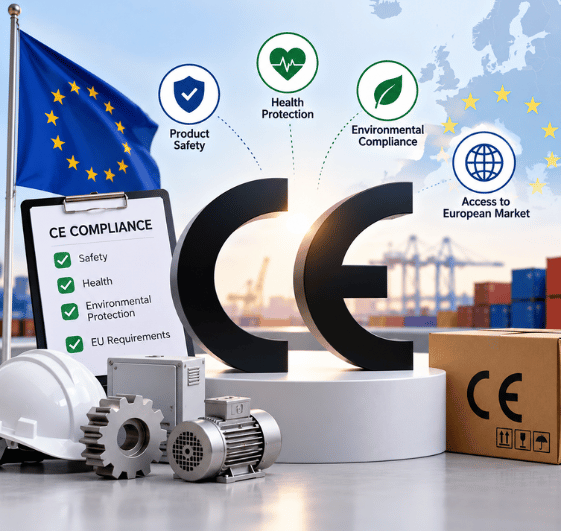
CE marking is a conformity mark that indicates a product meets the applicable European Union (EU) requirements for safety, health and environmental protection. It is required for many products sold in the European Economic Area (EEA).
The CE marking process depends on the product type and applicable EU regulations. It may involve product testing, risk assessment, technical documentation and a Declaration of Conformity. Manufacturers must fulfil the relevant requirements before affixing the CE mark to their products.
Importance of CE Compliance
Why Is CE Marking Important for Products?
CE Marking helps manufacturers demonstrate that their products meet the applicable European Union (EU) safety, health and environmental protection requirements. It is an important step for products covered by CE marking legislation that are intended to be placed on the European Economic Area (EEA) market.
For manufacturers and exporters, CE Marking can help demonstrate regulatory compliance, build customer confidence and support access to European markets, provided all applicable requirements are fulfilled.
EEA Market Access
Supports market access for qualifying products
Product Compliance
Meets applicable EU requirements
Technical Documentation
Technical file and Declaration of Conformity
Key advantages
Benefits of CE Marking Certification
A structured CE marking approach helps teams export with fewer surprises and stronger buyer confidence.
Organises technical documentation and Declaration of Conformity
Helps meet applicable product safety requirements
Identifies relevant EU regulations and product standards
Aligns product design, production, and labelling controls
Demonstrates conformity with applicable EU legislation
Builds buyer confidence through compliance documentation
Tracks product updates and changes affecting conformity
Supports CE compliance preparation for export markets
Who it is for
Who Needs CE Marking Certification?
CE marking applies to many product categories placed on the European market. Common examples include:
Industrial & consumer machinery
Electrical and electronic equipment
Medical devices (see also ISO 13485)
Toys and childcare products
Personal protective equipment (PPE)
Construction products
Pressure equipment & simple vessels
Automotive aftermarket components
Measuring instruments
OEM suppliers to EU brands
Amazon / marketplace sellers to the EU
Exporters shipping finished goods to Europe
How it works
CE Marking Certification Process
A practical sequence from product scope to CE mark readiness. Timelines depend on product risk class and how complete your technical file already is.
Step 1 – Product scope & EU rules
Identify the product category, applicable EU regulations or directives, and whether notified-body involvement is required.
Step 2 – Gap review
Review design, risk assessment, standards, labelling, and instructions against CE marking requirements for your product.
Step 3 – Technical documentation
Build or update the technical file: drawings, BOM, test reports, risk analysis, and quality records referenced in the conformity route.
Step 4 – Conformity assessment
Complete testing or audits required for your conformity module — self-assessment, third-party review, or notified-body steps where mandatory.
Step 5 – Declaration of Conformity
Issue the EU Declaration of Conformity with correct standards, legislation references, and responsible manufacturer details.
Step 6 – CE mark & upkeep
Apply CE marking per labelling rules and maintain the technical file when designs, suppliers, or regulations change.
FREQUENTLY ASKED QUESTIONS
Common Questions About CE Marking
It is the process of showing that a product meets EU rules for its category — through a technical file, conformity assessment, and an EU Declaration of Conformity — so the CE mark can be used where required.
No. ISO certificates cover management systems (for example ISO 9001). CE marking is product-specific EU conformity. Many companies use both: ISO for how they run the business, CE for how a product meets EU safety rules.
The manufacturer or authorised representative responsible for placing the product on the EU market must follow the correct conformity procedure and sign the Declaration of Conformity before using the CE mark.
Not all. Low-risk categories may allow manufacturer self-declaration. Higher-risk products (many medical devices, some machinery, PPE, and others) require notified-body involvement. The route depends on the product and regulation.
Typical items include product specifications, risk assessment, applicable harmonised standards, test reports, user instructions, labelling artwork, and the technical file structure your conformity route requires. ICV Assessments confirms the list after scoping your product.
Share your product type, target EU countries, and existing test reports via our request a quote page or contact form. We confirm applicable rules and the next assessment steps for your case.



Hi there! Need help?
Chat with us on WhatsApp for ISO certification and training.
Chat on WhatsApp +91 9711146710